Bold Voice Onboarding Teardown: How 5 Screens Carry the Entire Conversion Engine
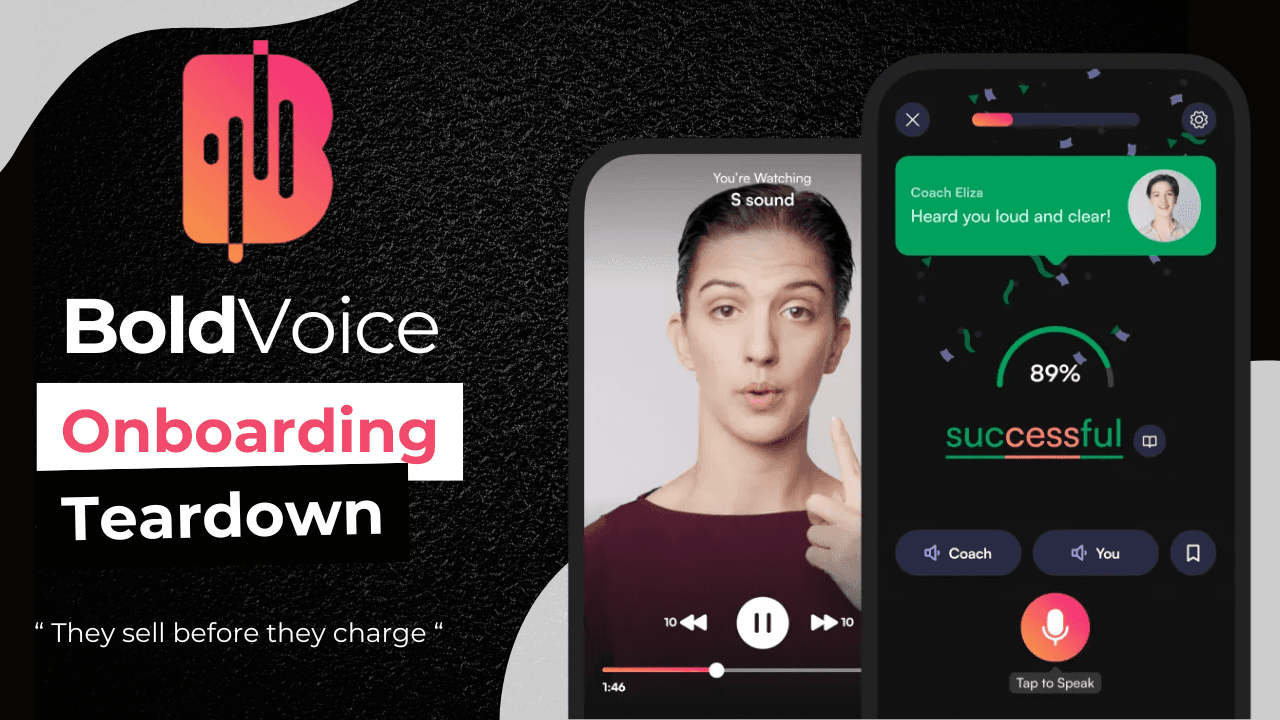
**Bold Voice Onboarding Teardown: How 5 Screens Carry the Entire Conversion Engine**
Most onboarding flows in mobile apps don’t fail because of bad design.They fail because the sequence is wrong.
Apps introduce value too late, ask for money too early, show features no one cares about, or dump personalization steps without ever preparing the user for why any of it matters.
Bold Voice is one of the rare apps that gets this sequencing right.Not by using flashy visuals or gimmicks, but by deliberately structuring the journey so the user is ready to buy long before the paywall appears.
Their onboarding has 31 screens, but only 5 screens do 90% of the conversion work.
Below is a full breakdown of what Bold Voice does differently, why it works, and how other apps can borrow these principles without copying the surface-level UI.
**1. The Setup: 31 Screens That Don’t Feel Like 31 Screens**
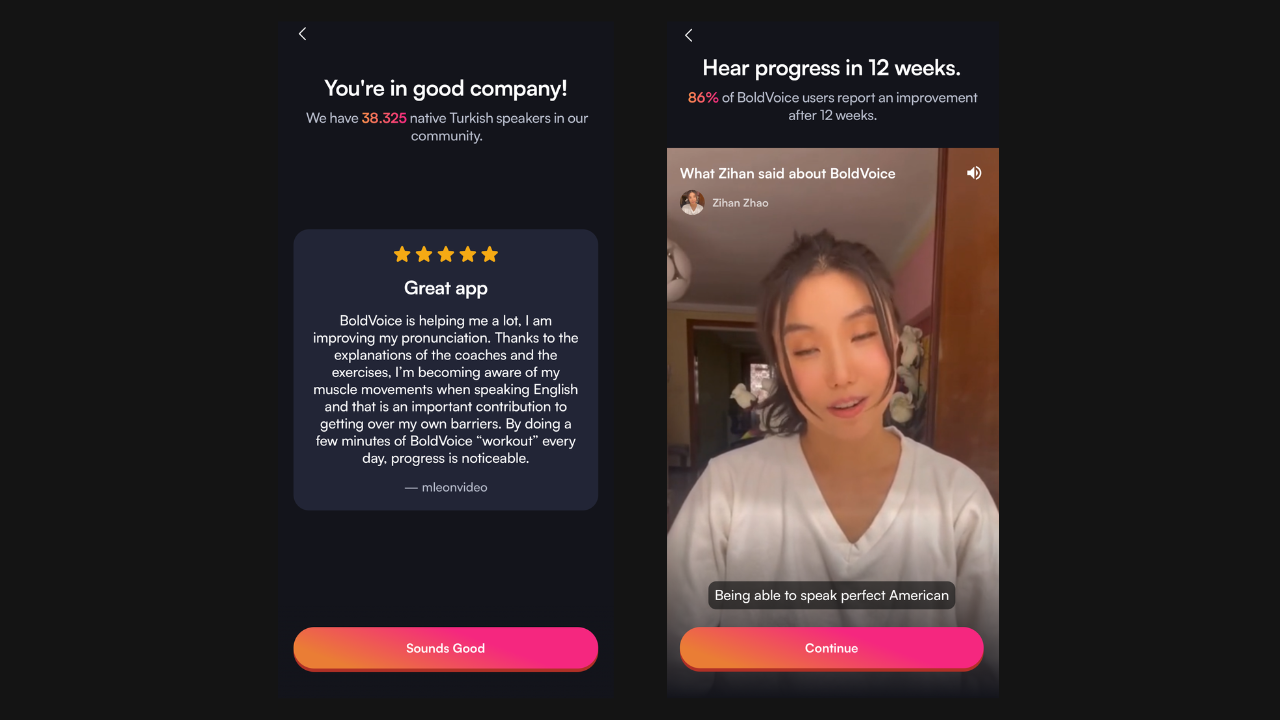
Bold Voice runs a long onboarding flow, but the user never feels trapped or slowed down.
Why?
Because the early steps follow familiar, low-friction patterns:
- Goals
- Skill level
- Practice habits
- Motivation
- Topic preferences
Nothing new. Nothing extraordinary.And that’s the point.
These steps collect context, but more importantly, they warm the user psychologically.
They create a sense of progression and investment.But Bold Voice doesn’t rely on this personalization alone, which is where most apps stall.
The differentiation begins later, exactly when users expect things to get boring.
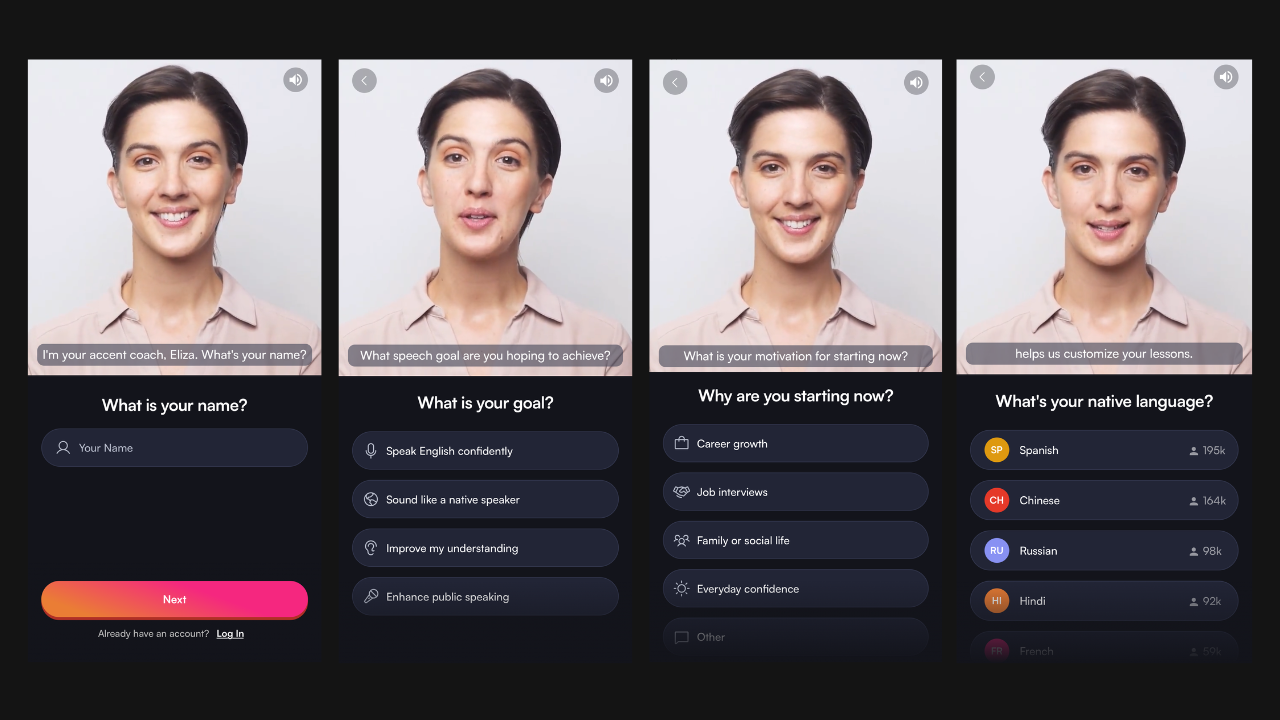
**2. Screen 13: The Expertise Intersection (The First Real Move)**
This screen is where Bold Voice breaks the pattern.
Instead of listing credentials or expertise in text-heavy paragraphs, they present a simple “intersection graphic”:
- Artificial Intelligence
- Harvard Research
- Hollywood Actors & Coaches
With Bold Voice positioned at the intersection.
This is brilliant for three reasons:
- Instant credibility without cognitive load.
- Authority stacking from three high-status domains.
- Pre-priming the user for a premium price point.
Most apps introduce “trust signals” too late.Bold Voice introduces them before expectations are shaped.That’s sequencing done right.
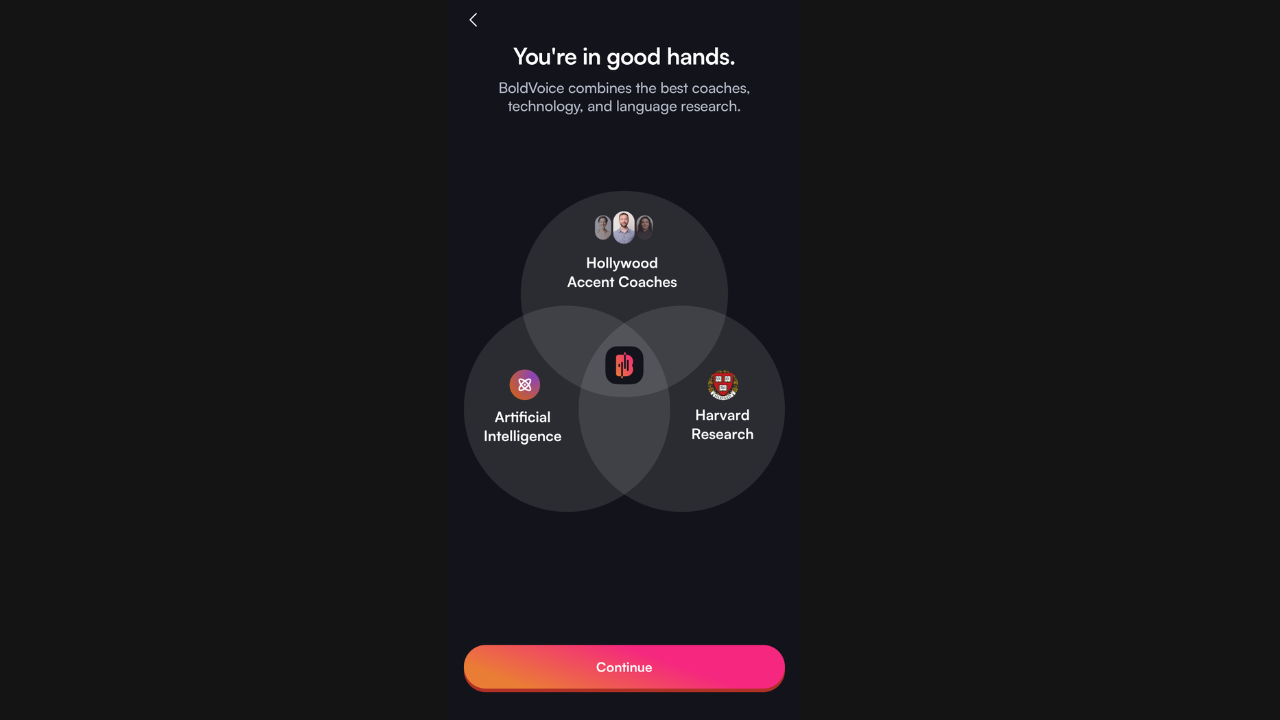
**3. Screen 17: Real User Testimonial Video (Pure Conversion Gold)**
Most onboarding flows rely on static claims like: “86% of users improved within 12 weeks.”
Bold Voice shows the same stat…but then immediately includes a real user testimonial video embedded inside onboarding.
This matters because:
- People trust faces, not text.
- A real story collapses skepticism.
- Emotion enters the funnel before the monetization step.
- It reframes the experience from “app” to “coach.”
This is different from showing testimonials on the paywall.It lands before purchase tension appears.
By the time users reach the pricing conversation, the testimonial has already done its job.
**4. Screens 21–26: The Value Tour (Raising Perceived Value Before Pricing)**
These screens preview the user’s “plan,” but the mechanics are subtle.
They show:
- Hollywood speech coaches (with photos, not credentials)
- AI-driven instant feedback
- Tailor-made curriculum using SpeechScan
- What the personalized plan contains
Individually, none of these features are unusual.But together, they form a guided value tour.
This works because:
- It maintains the pace between quiz → personalization → plan.
- It delivers value before the paywall instead of after it.
- It raises perceived value without overwhelming the user.
- It transitions the user from “answering questions” to “receiving benefits.”
This creates momentum, exactly what most onboarding flows lack.
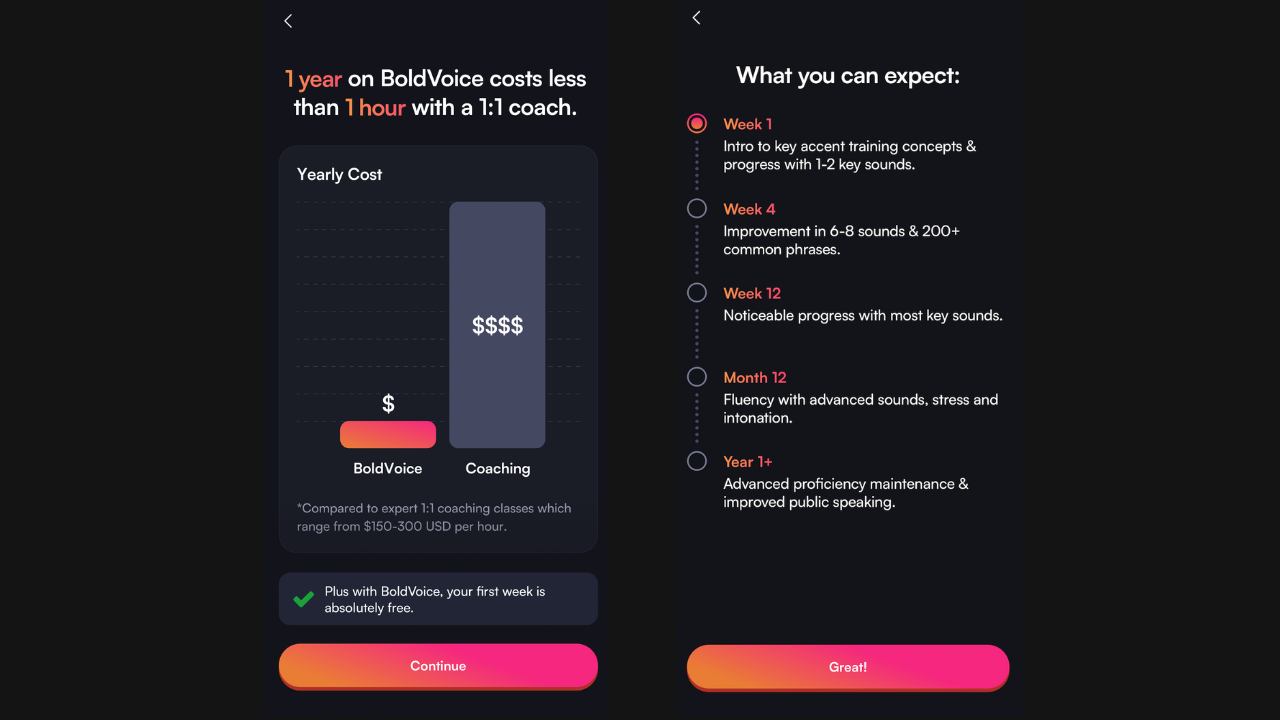
**5. Screen 29–30: The Chef’s Kiss - Timeline + Price Comparison**
This is the highest-impact moment in the entire onboarding.
Two screens do heavy conversion lifting:
**A. The Results Timeline**
Week 1 → Week 4 → Month 12 → Year 1
This turns an intangible skill (pronunciation) into a predictable progression. Users immediately visualize themselves improving over time.
This removes:
- Uncertainty
- Fear of slow progress
- Ambivalence about whether the app “works”
Expectation-setting is one of the strongest conversion levers in mobile apps. Bold Voice nails it.
**B. The Price Comparison**
“One year of Bold Voice costs less than one hour with a speech coach.”
This is an elite price anchor.
It reframes the price by comparing:
- A $100–$150/year subscription vs.
- A $100+/hour real-world coaching session
The brain instantly recalibrates.The subscription no longer feels like a cost.It feels like a saving.
Together, these two screens warm the user emotionally and rationally.By the time the paywall appears, tension is low and justification is high.
**6. The Strategic Layer Most Teams Miss**
The genius of Bold Voice is not the UI. It’s the value sequencing.
They follow a deliberate pattern:
Warm → Frame → Prove → Anchor → Charge
This sequencing prepares users to say yes before you ever show the paywall.
Most apps do the reverse:
- Show features too early
- Ask for money too soon
- Introduce credibility too late
- Show testimonials on the paywall instead of before
The order matters more than the visuals.
**7. The Bigger Lesson: Don’t Build Onboarding in Isolation**
Bold Voice’s onboarding works because the value props are coherent and connected.
But here’s the truth:
You don’t need to guess these angles.You don’t need to invent them.You don’t need to test onboarding blindly.
You should first test your value props in paid UA.
If an angle converts in ads, it will almost always convert in:
- Onboarding
- Paywalls
- Emails
- In-app nudges
Paid UA is where you discover the winners.Onboarding is where you scale them.
**Ads → Onboarding → Paywall is one loop, not three separate worlds.**
Treat them as separate departments, and you’ll keep leaking revenue.
**8. How Other Apps Can Apply This Today**
You don’t need 31 screens.You don’t need Hollywood coaches.You don’t need video production budgets.
What you do need is:
1. A credibility moment early in the flow Preferably visual. Preferably instant.
2. A real user moment Not testimonials buried in the paywall.
3. A guided value preview Not feature dumps.
4. A results timeline Expectation-setting is conversion fuel.
5. A strong price anchor Help users understand the “real world” cost alternative.
6. A feedback loop between paid UA and onboarding Stop building onboarding from scratch. Start building it from your paid UA winners.
**9. The Takeaway**
Bold Voice isn’t winning because of a beautiful onboarding.They’re winning because they sequence value intentionally.
The lesson for growth teams is simple:
Your onboarding is only as strong as the insights you bring into it. And your best insights come from paid UA.
If you turn ads → onboarding → paywall into one loop, you stop guessing and start compounding.
**Interested in applying this system to your app?**
At Otherwayaround, we help teams tie paid UA, onboarding, and paywalls into one connected growth loop instead of running them as isolated workflows.
Everything you saw in this teardown: sequencing value, validating angles in paid UA, translating winners into onboarding and paywalls, is exactly what our team builds for clients every day.
And starting January, OWA AI will automate a significant part of this system:
- Identifying your strongest value props from paid UA
- Suggesting onboarding and paywall variants aligned with those angles
- Running systematic hypothesis loops across ads, onboarding, and monetization
- Eliminating the guesswork that slows teams down
If you want to build a tighter, higher-performing growth engine:
→ [Join the OWA AI waitlist → [Get in touch with Otherwayaround to work with our team directly.